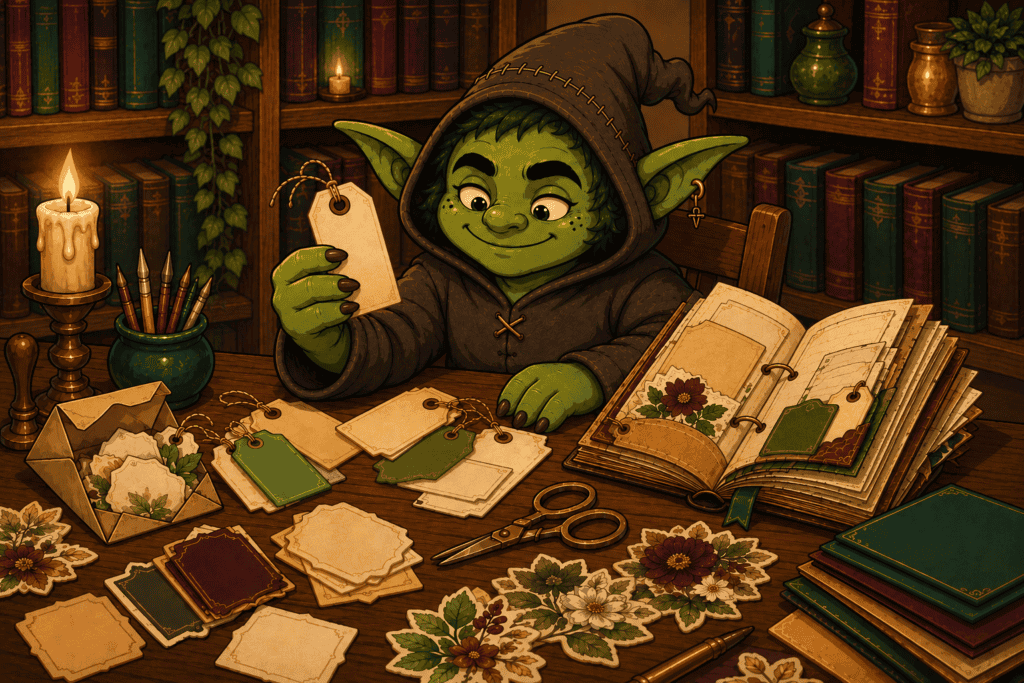
If you’ve spent any time around junk journals, you’ve run into the word ephemera — usually spoken with great confidence by people who assume you already know what it means. For the record, nobody is born knowing what it means. It’s a borrowed Greek word that translates, roughly, to “things that last a day.”
Which is the whole secret, actually. Ephemera is paper that was never meant to be kept. Ticket stubs. Postage stamps. Receipts. Seed packets. Luggage tags. Old labels off jars nobody remembers. For most of history this stuff went straight into the fire or the bin — and then collectors, scrapbookers, and junk journalers came along and decided the throwaway paper of ordinary life was the most charming paper of all.
They were right.
Ephemera vs. papers vs. pages — sorting out the words
Before we go further, a quick map, because shops (mine included) use a few overlapping terms:
Background papers are full sheets — patterned or scenic paper you use as the base of a page or cut into pieces. If it covers the whole page, it’s a paper.
Journal pages are full sheets designed to be written on — usually a scene or border with an open writing area, sometimes with lined and unlined versions.
Ephemera is the small stuff: individual elements designed to be cut out and layered — tags, labels, cards, envelopes, little illustrations. Ephemera is never the base of the page. Ephemera is the decoration, the texture, the “stuff” that makes a junk journal look collected instead of printed.
A junk journal wants all three, the way a dragon’s hoard wants gold and gems and at least one stolen crown.
The main types of printable ephemera
When you open an ephemera pack, here’s what you’re usually looking at, and what each piece is for:
Tags. The workhorses. Tie them in with twine, tuck them into pockets, use them as journaling spots or photo mats. If you only ever use one kind of ephemera, it’ll be tags.
Labels and journaling cards. Small framed spots designed to hold a few words — a date, a title, a caption, a stray thought. They give your handwriting a stage.
Envelopes and pockets. Fold-and-glue pieces that turn a flat page into a hiding place. Pockets are what make a junk journal interactive — something to open, pull out, tuck back in.
Fussy cuts. Individual illustrations meant to be carefully cut out (“fussy cut”) and layered wherever they please you. Flowers, animals, objects, little scenes.
Frames and borders. Open-centered pieces that dress up whatever you put inside them.
How to actually use it (the part nobody explains)
The trick to ephemera is that it works in clusters, not solos. A single tag glued flat in the middle of a page looks lonely. Three pieces overlapping — a tag, a scrap of background paper behind it, a fussy-cut flower slightly on top — suddenly looks like a page with history.
A few beginner-proof moves:
Layer in threes. Big piece at the back, medium in the middle, small detail on top. Vary the shapes.
Let things stick out. Tags peeking over the page edge, a card at a slight angle. Junk journals are allowed to be a little unruly — that’s the “junk” part working.
Make tuck spots. Glue a pocket or a belly band (a strip glued at both ends) onto a page, then tuck loose ephemera behind it. Nothing needs to be permanent.
Repeat colors, not pieces. A page holds together when the palette repeats, even when the pieces are wildly different.
There’s no wrong answer here. Ephemera is the lowest-stakes craft supply in existence — it was literally designed to be thrown away. You cannot ruin it. I find this deeply freeing.
Where to get ephemera
Free, from your actual life: junk mail, packaging, tea tags, receipts, maps, old book pages (from already-damaged books — I do not sanction the harming of healthy books). This is the traditional way, and it costs nothing but attention.
Printable packs: the modern shortcut. You download, print, and cut, and you get a whole coordinated set in one sitting — which is how you make a themed journal without waiting three years for your junk mail to develop a cohesive aesthetic.
If you’d like to try a printable set, two from my shop that play well with beginners: the Dreamy Meadow Ephemera pack — soft florals, tags, and envelopes — and the Vintage Workshop Ephemera pack, a rugged mechanic-and-garage set that proves ephemera doesn’t have to be dainty. Both are print-cut-and-go.
And if you want to test the waters for free first: the Goblin Reader Starter Kit has printable bookmarks to practice your cutting and layering on — grab it below and I’ll send it straight over.
The word may mean “lasts a day,” but fair warning: the hobby is permanent.
Leave a Reply